| Author |
Message |
CutRock
Joined: Dec 06, 2010
Posts: 10
Location: Chicago
|
 Posted: Tue Mar 06, 2012 9:16 am Post subject:
Need a simple voltage decay circuit Posted: Tue Mar 06, 2012 9:16 am Post subject:
Need a simple voltage decay circuit |
  |
|
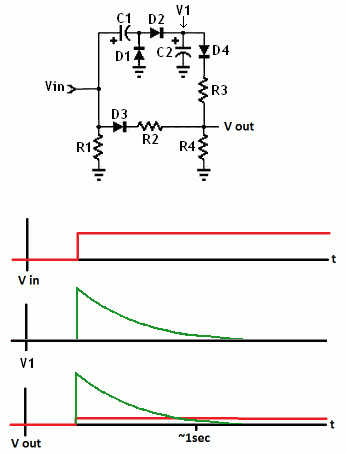
My goal is to produce a circuit that will pulse a high voltage for about a second before dropping down to a lower voltage once the device turns on (the simpler the better!). I assumed this would be relatively easy, but all the intuitive solutions that I've come up with haven't really worked out.
I'd appreciate any feedback or suggestions, or even just some key words to start searching for when trying to find a solution.

One thing to note: I drew the drop-off as a linear decline in voltage for V_out, but it could potentially be exponential decay or discrete, dropping almost instantly from the high voltage to the low voltage. [/img] |
|
|
Back to top
|
|
 |
PHOBoS
Joined: Jan 14, 2010
Posts: 5895
Location: Moon Base
Audio files: 709
|
|
|
Back to top
|
|
|
fonik

Joined: Jun 07, 2006
Posts: 3950
Location: Germany
Audio files: 23
|
| Posted: Tue Mar 06, 2012 1:12 pm Post subject:
|
|
|
so a simple passive RC network (time constant) didn't work for you? the decay would not be linear, of course.
(i used this as part of an ignition system for the ADC in my sequencer)
_________________

cheers,
matthias
____________
Big Boss at fonitronik
Tech Buddy at Random*Source |
|
|
Back to top
|
|
|
richardc64

Joined: Jun 01, 2006
Posts: 679
Location: NYC
Audio files: 26
|
|
|
Back to top
|
|
|
JingleJoe

Joined: Nov 10, 2011
Posts: 878
Location: Lancashire, England
Audio files: 14
|
| Posted: Tue Mar 06, 2012 2:32 pm Post subject:
|
|
|
I made a similar thing once from a 40106 schmitt trigger based monostable circuit, of course one would need a buffer/voltage follower to get the decaying voltage from the cap without affecting the charge/discharge time.
Hmm thinking about it, if using that method one may also need a trigger pulse generator, not too hard to make from a cap and another schmitt trigger.
Circuit diagram of what I'm rambling about provided on request.
_________________
As a mad scientist I am ruled by the dictum of science: "I could be wrong about this but lets find out"
Green Dungeon Alchemist Laboratories |
|
|
Back to top
|
|
|
CutRock
Joined: Dec 06, 2010
Posts: 10
Location: Chicago
|
| Posted: Tue Mar 06, 2012 4:23 pm Post subject:
|
|
|
Thanks for all the input, guys. I'm only slightly EE literate, so I'm sorry if the solution was extremely obvious. I had seen a couple circuits with a voltage source that charged a capacitor, which was then discharged through a resistor to give a decaying voltage, but these all seemed to require a physical switch of some sort. This application will need to be completely automated so that when the voltage is provided, that voltage peaks for a second or so, then decays to a lower voltage.
It looks like the circuit proposed by richardc64 (and also fonik?) will be fine. I'll play around with it when I have some free time.
Thanks for all the help! |
|
|
Back to top
|
|
|
fonik
Joined: Jun 07, 2006
Posts: 3950
Location: Germany
Audio files: 23
|
| Posted: Tue Mar 06, 2012 11:44 pm Post subject:
|
|
|
under certain circumstances the ADC i used in my VCPS-8 needed a momentary connection of one pin to GND to start working properly.
i just used a cap fed by the 5V line and a resistor to ground to create a short pulse whenever the power is switched on. this short pulse then triggers a transistor to switch the ICs pin to GND. works perfectly.
_________________
cheers,
matthias
____________
Big Boss at fonitronik
Tech Buddy at Random*Source |
|
|
Back to top
|
|
|
CutRock
Joined: Dec 06, 2010
Posts: 10
Location: Chicago
|
| Posted: Wed Mar 07, 2012 9:00 am Post subject:
|
|
|
Thanks all! Got it working relatively quickly - turns out you have to type "Meg" for millions of ohms and not just "M" in LTSpice (which makes it milliohms). After that little snaffu, it turned out to be relatively straightforward. I ended up using Fonik's ADC ignition setup and a couple pots to tune the peak height and the voltage that it eventually decays to.
Despite the simplicity, I figured I should still post my final results:
 |
|
|
Back to top
|
|
|
beep

Joined: May 05, 2013
Posts: 105
Location: Germany
|
| Posted: Fri May 10, 2013 12:26 pm Post subject:
|
|
|
| richardc64 wrote: |

|
Yaaay, I love this!
R4 determines decay time, doesn't it? but it will also affect the output voltage,
when I try this circuit in the falstad simulator |
|
|
Back to top
|
|
|
beep
Joined: May 05, 2013
Posts: 105
Location: Germany
|
|
|
Back to top
|
|
|
|


 Forum index » DIY Hardware and Software

 FAQ
FAQ Calendar
 Search
 Memberlist
 Usergroups
 Register
 Profile
 Log in to check your private messages
 Log in
 Chat Room