| Author |
Message |
ChrisC
Joined: Oct 04, 2008
Posts: 18
Location: Canada
|
 Posted: Sat Oct 04, 2008 11:39 am Post subject: Posted: Sat Oct 04, 2008 11:39 am Post subject:
|
  |
|
Hi all,
Long time lurker here, but I registered to let you know how totally excited I am about this project. This is exactly the sort of input device I've always wanted. Thank you very much for all the work so far! It sounds awesome!
Pretty sure that my level of honest heart-racing excitement upon reading this thread seals the deal on my geekiness. 
Thanks again!
-Chris |
|
|
Back to top
|
|
 |
Scott Stites
Janitor


Joined: Dec 23, 2005
Posts: 4127
Location: Mount Hope, KS USA
Audio files: 96
|
| Posted: Sat Oct 04, 2008 12:01 pm Post subject:
|
|
|
 Chris! Chris!
Geekiness is an asset in this forum.
I've been working on this project since August, when the SoftPots actually showed up at my door. I'm just polishing off the details, but the circuit is pretty much where I want it now. I've got a list of gazzins and gazzouts that I've been working on.
I'm working on getting my personal technology up to be able to post YouTube stuff - sound samples don't really make what it's doing apparent, but a video would. It gives you a lot of power at your appendage-tips.
Take care,
Scott
_________________
My Site |
|
|
Back to top
|
|
|
Scott Stites
Janitor
Joined: Dec 23, 2005
Posts: 4127
Location: Mount Hope, KS USA
Audio files: 96
|
|
|
Back to top
|
|
|
Sound
Joined: Jun 06, 2006
Posts: 842
Audio files: 1
|
| Posted: Sat Oct 04, 2008 2:44 pm Post subject:
|
|
|
Scott,
I understood that the ribbon control has linear response, I mean that controlling pitch its behavior is the same than a keyboard =distance=music interval
It is possible that this Ribbon will have Log response? I mean that controlling pitch its behavior will be like a string?
Many Thanks. |
|
|
Back to top
|
|
|
Sound
Joined: Jun 06, 2006
Posts: 842
Audio files: 1
|
| Posted: Sat Oct 04, 2008 3:16 pm Post subject:
|
|
|
Aha! I found it:
| Quote: | | I've said little about it, but for some time now, the Appendage has been producing a fourth voltage I've come to call TFS (short for Two Fingered Salute, not the other meaning). This voltage reflects the distance between points of pressure in the form of a positive voltage. Using voltage to feed the ribbon, the response of this voltage is roughly logarithmic - it is not a linear relationship. The farther apart the two points of pressure are, the more sharply it will rise. It's a musically pleasing response, particularly when controlling a filter. |
It will be the same pitch response than a string? |
|
|
Back to top
|
|
|
ChrisC
Joined: Oct 04, 2008
Posts: 18
Location: Canada
|
Posted: Sat Oct 04, 2008 3:52 pm Post subject:
 |
|
|
Looking great! Thanks for the update!
-Chris |
|
|
Back to top
|
|
|
Scott Stites
Janitor
Joined: Dec 23, 2005
Posts: 4127
Location: Mount Hope, KS USA
Audio files: 96
|
| Posted: Sat Oct 04, 2008 6:32 pm Post subject:
|
|
|
The TFS voltage is fairly logrithmic in voltage mode - I'll have to figure out a way to graph the curve. In current mode, it's linear. TFS is not held by the S&Hs (IE, when you release the second pressure point, TFS will go to zero). Initial, Slide and Bend are held in the S&Hs on release.
TFS is a pretty cool thing - it will always go up in voltage, no matter if your second pressure point is above or below the first pressure point. The mix section allows TFS to be mixed (as it does all of the voltages). The spiffy thing here is that you can dial in just Initial Note voltage and use TFS with it. Initial will hold a value until you release, then reapply a different point. Now, using initial voltage, you can control a VCO while controlling some other functions with bend and slide. So, you can hold a note and dynamically change the timbre of the note (filter, PWM, wave shaping, whatever). But! - if you mix in TFS, you can change the pitch at any time by applying a second pressure point above or below the current position of the point of pressure. Closer together, the pitch will rise slightly, farther apart, the pitch rises further. If you were a dog, you could enjoy raising the pitch of the VCO ten full octaves above *any* note initially played, if you so wanted to .
TFS is also the only ribbon voltage to remain active in S&H mode (along with the gate and trigger). You can use the ribbon to bend the pitch of the S&H voltage around. One thing I did last night was use TFS to control a VCO that allowed me to "slide in" any amount of FM to the modulation input while the S&H was running.
There are really two S&H modes - both modes take a gate input and a signal input, which allows the three modes I've discussed before (1. Tapping the ribbon takes each sample, 2. Pressing the ribbon gates the S&H clock input, letting you control when the sampling occurs and doesn't and 3. Full auto sampling, external gate signal controls the sampling).
The other mode is a special mode that's suited more for stepped voltages such as keyboards or sequencers. This mode accepts the keyboard or sequencer gate, and uses that signal to determine when to sample. However, it creates its own gate and trigger outputs. This is because the sampled signal is passed through the same logic that interprets the ribbon voltage to derive the same signals.
The cool thing about this mode is that the AutoGlide kicks in on the keyboard/sequencer input. If you press a succession of single keys, there is no glide. If you hold down one key, the voltage glides between notes. I tried this with a Klee sequence as well, which can hold a gate voltage over succession of steps from the sequencer (when using the merge function). In this case, Appendage picked out a slow, walking sustained sequence that was a subset of the Klee sequence, and when the gate held high, the Appendage would glide those notes (if I wanted it too). Very cool thing. The Appendage puts out gate and trigger signals in these modes. The hypertrigger, in this case, will re-trigger on any new notes, just like a "normal" keyboard.
Another very cool think is that the Appendage provides three outputs in any sampling mode. In this mode, you can get a sort of duophony from a keyboard or a sequencer. The initial note output always holds the value of the first note played. The slide output, however, tracks the input. So, controlling two VCOs, when you press the first key, both VCOs play in unision. As long as you keep a key of the keyboard held down while you continue to play other keys, one VCO will hold the initial note, and the other VCO will track the keyboard. The bend output will always output the voltage representing the interval between the two notes. Applying this voltage to the filter is very spiffy.
I've been testing the crap out of this circuit, but, I gotta say, it's a helluva lot of fun testing it . 
Cheerios,
Scott
_________________
My Site |
|
|
Back to top
|
|
|
bugfight

Joined: Aug 02, 2007
Posts: 188
Location: Arlington, TX USA
|
| Posted: Sat Oct 04, 2008 9:33 pm Post subject:
|
|
|
just gets better and better.
i'm itchin to see them vids...
whatcha need to get them rockin? |
|
|
Back to top
|
|
|
Scott Stites
Janitor
Joined: Dec 23, 2005
Posts: 4127
Location: Mount Hope, KS USA
Audio files: 96
|
| Posted: Sat Oct 04, 2008 9:50 pm Post subject:
|
|
|
(A) Make the videos
(B) Get something other than dial-up
(C) Get a real computer
Bill's been helping me out quite a bit with getting to that point.
Cheerios,
Scott
_________________
My Site |
|
|
Back to top
|
|
|
bugfight
Joined: Aug 02, 2007
Posts: 188
Location: Arlington, TX USA
|
| Posted: Sun Oct 05, 2008 5:46 am Post subject:
|
|
|
hmmmm how about a stites 'real computer' fund?
i bet the community would jump on that, seeing
how you have given so much already, and the vids
would benefit us all.
i know i would...
you gots a paypal account? |
|
|
Back to top
|
|
|
Scott Stites
Janitor
Joined: Dec 23, 2005
Posts: 4127
Location: Mount Hope, KS USA
Audio files: 96
|
| Posted: Sun Oct 05, 2008 7:15 am Post subject:
|
|
|
That's very kind of you, but the computer situation is being rectified as we speak. Or...err....write.
_________________
My Site |
|
|
Back to top
|
|
|
frijitz
Joined: May 04, 2007
Posts: 1734
Location: NM USA
Audio files: 54
|
| Posted: Sun Oct 05, 2008 8:42 am Post subject:
|
|
|
| Sound wrote: | I understood that the ribbon control has linear response, I mean that controlling pitch its behavior is the same than a keyboard =distance=music interval
It is possible that this Ribbon will have Log response? I mean that controlling pitch its behavior will be like a string? |
That's what I'm interested in also. It might not be too hard to get used to the linear response, but what's really needed is high-note priority with pitch increasing to the right.
I made a couple of diy ribbons a few weeks back and started some experiments with them. I had trouble with the range of resistances being hard to work with (6 Ohm for one, 200k for the other) so I got a couple of softpots to try. If I get serious about this I will probably do most of the signal processing in a PIC. That way I can more easily experiment with different processing algorithms and also easily spit out a MIDI stream.
At some point we may want to split off a separate thread for the uC-based approach.
Ian |
|
|
Back to top
|
|
|
Scott Stites
Janitor
Joined: Dec 23, 2005
Posts: 4127
Location: Mount Hope, KS USA
Audio files: 96
|
| Posted: Sun Oct 05, 2008 10:23 am Post subject:
|
|
|
A keyboard is a linear device, so if you're used to using a keyboard, there's nothing to get used to.
The mix section allows left or right note priority in current mode, for hammer-ons (or two point pressure) which is where note-priority is applicable.
_________________
My Site |
|
|
Back to top
|
|
|
Scott Stites
Janitor
Joined: Dec 23, 2005
Posts: 4127
Location: Mount Hope, KS USA
Audio files: 96
|
| Posted: Sun Oct 05, 2008 12:17 pm Post subject:
|
|
|
This is one reason why I feel videos would be more demonstrative - it's just as important to show how a particular gesture is made as to what the gesture sounds like. Writing about things like note priority, etc. (which I have already) doesn't really convey the actual experience.
I've configured the Appendage so as to provide a much more versatile controller than what one associates the term "ribbon controller" with. It's also why I always refer to it as a "touch ribbon", because of that. Pitch control is only one duty I have in mind.
The mix section allows one to build any response one wants for control. As an example, I just recorded a short quickie using just one particular setup. If you were to see a video of this rather than listen to a sample, you would see that there is no two pressure note priority in this configuration - voltage mode doesn't care one whit about priority.
This sample does not use the slide voltage. Instead, it uses the initial note voltage mixed with the bend voltage. One can dial in as much "bend" as one wants.
The sample begins using bend voltage to produce trills. These can be hammered above or below the initial note. The speed of these trills belies the fact that I am hammering on *above* mainly because I can't move my left hand that fast. *Above* would be high note priority, except, as I said, Voltage Mode doesn't care.
This patch also has an LFO going through a VCA into the modulation input. The VCA is controlled by the TFS voltage. When there is a very wide spread between pressure points, then this LFO vibrato will blend in.
I'm using a single sine wave VCO.
Between 0 and :0036 you can hear the trills.
At 00:36 I spread TFS to bring in the LFO.
At 00:42 there is some sliding (using bend) as I adjust the AutoGlide pot up. Now the AutoGlide is kicking in on the hammer-ons. This transforms trills into vibrato. All of the "vibrato" you hear at this point is hammers on that glide, while individual notes are stepped (unless I slide them).
At 1:00 you can hear the AutoGlide more dramatically as I increase the distance between fingers for the hammer-ons.
Right now, the Appendage is pretty much in the can. The signal acquisition is perfect - you touch the ribbon, it sings, you release, it holds. It's very agile, and very responsive, and very rubbery when you start cranking on the Autoglide. The mix section in a complex patch comes up with some very surprising responses. It's the most fun I've had with a circuit since the Klee, if not ever.
| Description: |
| Appendage controlling a sine wave VCO |
|

Download (listen) |
| Filename: |
appendage_sine.mp3 |
| Filesize: |
2.29 MB |
| Downloaded: |
1303 Time(s) |
_________________
My Site |
|
|
Back to top
|
|
|
Scott Stites
Janitor
Joined: Dec 23, 2005
Posts: 4127
Location: Mount Hope, KS USA
Audio files: 96
|
| Posted: Sun Oct 05, 2008 12:49 pm Post subject:
|
|
|
Here's the patch I had going before the previous sample. It's using the Appendage S&H section, but not the ribbon.
The Klee A+B output is patched into the sample input of the Appendage. The Klee Gate Bus 1 is patched into the gate input of the Appendage. The Slide outut voltage is controlling the pitch of one VCO and the Initial Note output is controlling the pitc of another VCO. Both of these VCOs are patched into the filter and through the VCA. The Appendage gate and trigger outputs are controlling the envelope generator, which is patched to the VCA and the filter.
In the sample, I'm only merging and unmerging Gate Bus 1. When Gate Bus 1 is unmerged, all of the gates for each note are separate. So, both voltage outputs of Appendage sample each voltage when its gated. When Gate Bus 1 is merged, adjacent "notes" combine to form a single gate signal. When this happens, the VCO controlled by the Initial Note output holds at the rising edge of the extended gates, while the VCO controlled by the Slide output continues to track the Klee output.
Towards the end, I nudge up AutoGlide on the Appendage. Now, when the gates are merged, the merged notes on the slide output glide.
| Description: |
| Appendage processing Klee voltage and gates |
|
Download (listen) |
| Filename: |
appendage_klee.mp3 |
| Filesize: |
3.26 MB |
| Downloaded: |
1251 Time(s) |
_________________
My Site |
|
|
Back to top
|
|
|
ringer

Joined: Feb 20, 2007
Posts: 49
Location: montreal
|
| Posted: Sun Oct 05, 2008 2:39 pm Post subject:
|
|
|
Hi Scott,
Fantastic stuff!!! New territories of expression and control, Kudos again.
Cheers,
ringer
Last edited by ringer on Mon Oct 06, 2008 5:52 am; edited 1 time in total |
|
|
Back to top
|
|
|
State Machine
Janitor

Joined: Apr 17, 2006
Posts: 2810
Location: New York
Audio files: 24
|
| Posted: Sun Oct 05, 2008 5:15 pm Post subject:
|
|
|
| Quote: | | In the sample, I'm only merging and unmerging Gate Bus 1. When Gate Bus 1 is unmerged, all of the gates for each note are separate. So, both voltage outputs of Appendage sample each voltage when its gated. When Gate Bus 1 is merged, adjacent "notes" combine to form a single gate signal. When this happens, the VCO controlled by the Initial Note output holds at the rising edge of the extended gates, while the VCO controlled by the Slide output continues to track the Klee output. |
I find this one of the more interesting aspects of the S/H features of the Appendage. I really like the swelling notes playing against the main note line in this sample. A nice extension of the Klee's already comprehensive set of modulation possibilities  Nice Job Scott. Nice Job Scott.
Bill |
|
|
Back to top
|
|
|
aetherpulse
Joined: Jun 13, 2007
Posts: 29
Location: oregon
|
| Posted: Sun Oct 05, 2008 7:35 pm Post subject:
|
|
|
| Those last two mp3's are super cool! I must have at least two of these and it also reminds me that I need to get to building my Klee! |
|
|
Back to top
|
|
|
Scott Stites
Janitor
Joined: Dec 23, 2005
Posts: 4127
Location: Mount Hope, KS USA
Audio files: 96
|
| Posted: Mon Oct 06, 2008 1:34 pm Post subject:
|
|
|
It's proving to make a nice complement to the Klee - it's fun to feed the Klee external range with it, or to pipe the Klee into the external signal input, or modulation input.
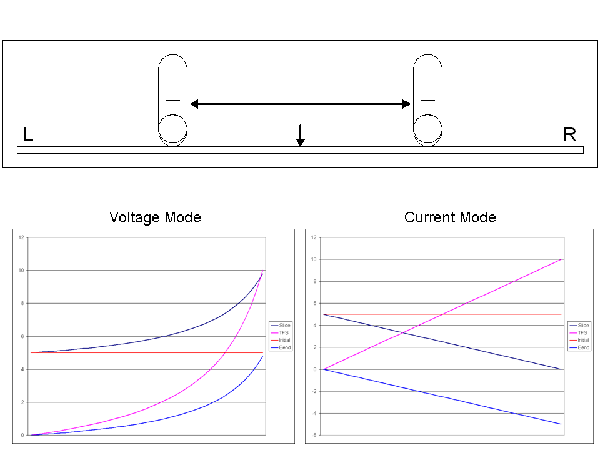
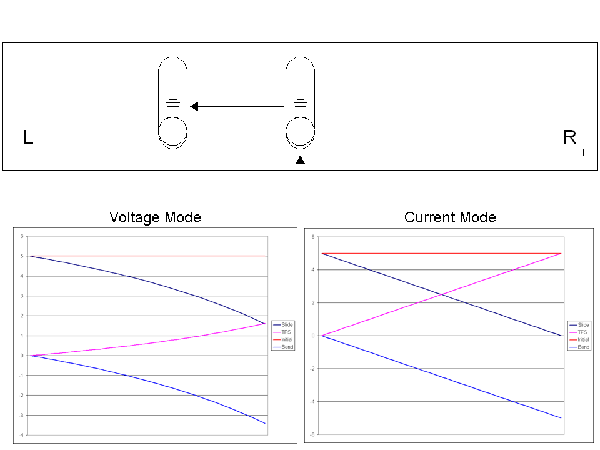
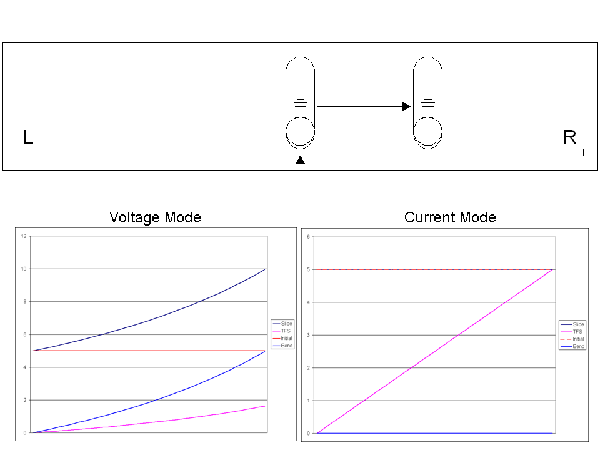
Here are some voltage graphs of two pressure point voltages (IE, using two fingers). The single pressure point response between voltage and current mode is the same - linear positional voltage on slide, linear bend voltage, 0V TFS, with initial voltage reflecting the initial point of contact.
However, once you apply two fingers, the differences are rather profound, and created a huge internal conflict with me as to choosing which method to use. I finally decided on my standard "cake and eat it, too approach" because there are so many advantages of one over the other.
These graphs only show a few instances - things vary considerably for voltage response, depending on where you start and end up. These graphs just concentrate on what happens when starting from the middle.
Center_Spread.png shows the response when starting at the middle with two pressure points and spreading both fingers out to the ends of the ribbon.
Middle_Down.png shows the response when starting at the middle, and moving the left finger down all the way to the end while keeping the right finger in the middle.
Middle_Up.png shows the response when starting at the middle, and moving the right finger up all the way to the end while keeping the left finger in the middle.
As can be seen, the responses between voltage and current mode are pretty interesting. It's not obvious from the graphs what some of the implications are (particularly when mixing voltages or when controlling things from TFS), but I guess some were interested in the response curves. You can see why I like to think of Voltage two finger operation as "West Coast" and Current two finger operation as "East Coast". Current is all straight lines and linearity, A to B, and Voltage likes to take the scenic route....
Just like music....
| Description: |
|
| Filesize: |
36.3 KB |
| Viewed: |
217 Time(s) |
| This image has been reduced to fit the page. Click on it to enlarge. |
|
| Description: |
|
| Filesize: |
35.85 KB |
| Viewed: |
231 Time(s) |
| This image has been reduced to fit the page. Click on it to enlarge. |
|
| Description: |
|
| Filesize: |
30.1 KB |
| Viewed: |
233 Time(s) |
| This image has been reduced to fit the page. Click on it to enlarge. |
|
_________________
My Site |
|
|
Back to top
|
|
|
frijitz
Joined: May 04, 2007
Posts: 1734
Location: NM USA
Audio files: 54
|
| Posted: Mon Oct 06, 2008 6:28 pm Post subject:
|
|
|
Those are absolutely eye-popping, jaw-dropping demos. You've done more than develop another alternate controller -- you've invented a whole new way of making music.
Watch you don't get ripped off. There could be some money made with this.
Ian |
|
|
Back to top
|
|
|
Scott Stites
Janitor
Joined: Dec 23, 2005
Posts: 4127
Location: Mount Hope, KS USA
Audio files: 96
|
| Posted: Tue Oct 07, 2008 10:55 am Post subject:
|
|
|
Now if I could just learn how to play it....
_________________
My Site |
|
|
Back to top
|
|
|
blue hell
Site Admin

Joined: Apr 03, 2004
Posts: 24610
Location: The Netherlands, Enschede
Audio files: 310
G2 patch files: 320
|
| Posted: Tue Oct 07, 2008 12:44 pm Post subject:
|
|
|
| Scott Stites wrote: | | Now if I could just learn how to play it.... |
The money game? You can't possibly be worse than the ones currently doing it.
Or playing the ribbon? Take your time, an hour at least each day, better more, it shouldn't be much harder than playing the violin 
I think Ian may be right about the ripoff risk, this is pretty unique and very usable.
_________________
Jan
also .. could someone please turn down the thermostat a bit.
 |
|
|
Back to top
|
|
|
aetherpulse
Joined: Jun 13, 2007
Posts: 29
Location: oregon
|
| Posted: Tue Oct 07, 2008 9:01 pm Post subject:
|
|
|
| I could easily see this as a commercial product. I think modulars have been crying out for something other than a traditional keyboard for a controller. Most of my Buchla and serge lust is because of their alternate controller schemes. This seems like it would fill this need for diy stuff. I can't wait to get my hands on a couple of them! |
|
|
Back to top
|
|
|
StephenGiles
Joined: Apr 17, 2006
Posts: 507
Location: England
|
| Posted: Wed Oct 08, 2008 3:14 am Post subject:
|
|
|
| Now if Jeff Beck got his hands on one.......... |
|
|
Back to top
|
|
|
numbernone
Joined: Aug 16, 2006
Posts: 477
Location: new york city
|
| Posted: Mon Nov 03, 2008 11:15 am Post subject:
|
|
|
Any news on the APPENDAGE? Has it been zipped up and put away?
Since some of the posts alluded to its obvious commercial potentials, should I assume that some kind of arrangements are being made to offer a fully realized product? I can understand not wanting to be Doepferized, and am surprised no one has ripped off the Klee yet.
Still hoping for a DIY version. |
|
|
Back to top
|
|
|
|


 Forum index » DIY Hardware and Software

 FAQ
FAQ Calendar
 Search
 Memberlist
 Usergroups
 Register
 Profile
 Log in to check your private messages
 Log in
 Chat Room


